Adobe ColdFusion Pre-Authentication Unrestricted File Upload and Path Traversal Vulnerabiliti 2026-7-7 17:25:19 Author: horizon3.ai(查看原文) 阅读量:27 收藏
Adobe ColdFusion Pre-Authentication Unrestricted File Upload and Path Traversal Vulnerabilities
Adobe has released security updates for multiple vulnerabilities affecting Adobe ColdFusion, including two Critical vulnerabilities tracked as CVE-2026-48283 and CVE-2026-48313. CVE-2026-48283 is an unauthenticated unrestricted file upload vulnerability that can lead to remote code execution, while CVE-2026-48313 is an unauthenticated path traversal vulnerability in the ColdFusion CKEditor filemanager connector that can expose sensitive files outside the intended directory structure. Both vulnerabilities affect Adobe ColdFusion 2025 Update 9 and earlier and Adobe ColdFusion 2023 Update 20 and earlier. Adobe has stated it is not aware of either vulnerability being exploited in the wild at the time of publication.
Technical Details
Adobe ColdFusion is a commercial web application development platform widely used across government, healthcare, financial services, higher education, and enterprise environments to build and host dynamic web applications.
CVE-2026-48283 is an unauthenticated unrestricted file upload vulnerability (CWE-434) that can result in arbitrary code execution. A remote attacker can upload a malicious file to a vulnerable ColdFusion server without authentication or user interaction, resulting in code execution in the context of the current ColdFusion service account. The vulnerability has a CVSS v3.1 score of 10.0 (Critical).
CVE-2026-48313 is an unauthenticated path traversal vulnerability (CWE-22) affecting the ColdFusion CKEditor filemanager connector. Successful exploitation allows an attacker to read sensitive files outside the intended directory structure and perform limited file writes. Configuration files containing credentials or other sensitive information may also be exposed, enabling additional compromise. The vulnerability has a CVSS v3.1 score of 9.3 (Critical).
Both vulnerabilities have a changed scope, meaning successful exploitation can impact resources beyond the vulnerable ColdFusion instance itself. Although Adobe has not observed exploitation in the wild, both vulnerabilities require no authentication and are remotely exploitable, making them high-priority patching targets.
Stop Guessing, Start Proving
NodeZero® Proactive Security Platform — Rapid Response
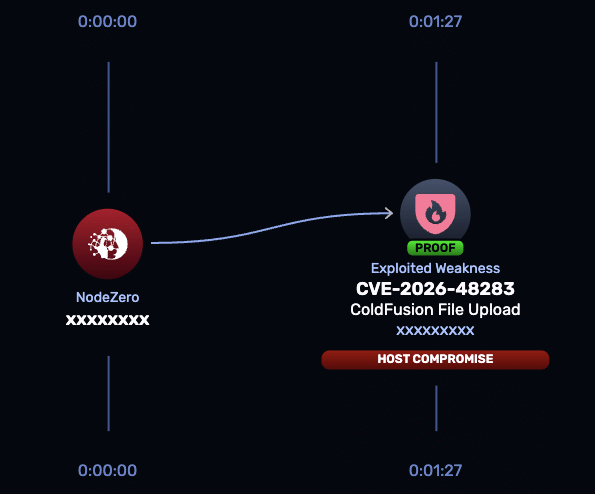
A NodeZero Rapid Response test has been developed to safely validate whether these vulnerabilities can be exploited in your environment. The test executes real attack techniques without causing damage, giving security teams immediate clarity into whether vulnerable Adobe ColdFusion instances are actually exploitable.
- Run the Rapid Response test: Launch the Rapid Response test from the NodeZero platform to determine whether CVE-2026-48283 or CVE-2026-48313 can be exploited in your environment.
- Patch immediately: Upgrade to Adobe ColdFusion 2025 Update 10 or Adobe ColdFusion 2023 Update 21, or implement Adobe’s recommended mitigations if immediate patching is not possible.
- Re-run the test: Confirm the vulnerabilities are no longer exploitable after remediation.
Affected versions & patch
Affected
- Adobe ColdFusion 2025 Update 9 and earlier
- Adobe ColdFusion 2023 Update 20 and earlier
Fixed
- Adobe ColdFusion 2025 Update 10
- Adobe ColdFusion 2023 Update 21
Mitigations
Adobe recommends updating affected ColdFusion installations immediately. If immediate patching is not possible, organizations should restrict network access to ColdFusion administration interfaces and file upload functionality until the updates can be applied.
Timeline
- June 30, 2026: Adobe published Security Bulletin APSB26-68 and disclosed CVE-2026-48283 and CVE-2026-48313.
- June 30, 2026: Adobe released ColdFusion 2025 Update 10 and ColdFusion 2023 Update 21 to remediate the vulnerabilities.
- June 30, 2026: Adobe reported it was not aware of any exploitation of either vulnerability in the wild.
- July 1, 2026: Public reporting highlighted the Critical vulnerabilities and recommended organizations apply the updates immediately.
- July 7, 2026: Horizon3.ai released a NodeZero Rapid Response test to help customers validate exposure and verify remediation.
References
Read about other CVEs
NodeZero® Platform
Implement a continuous find, fix, and verify loop with NodeZero
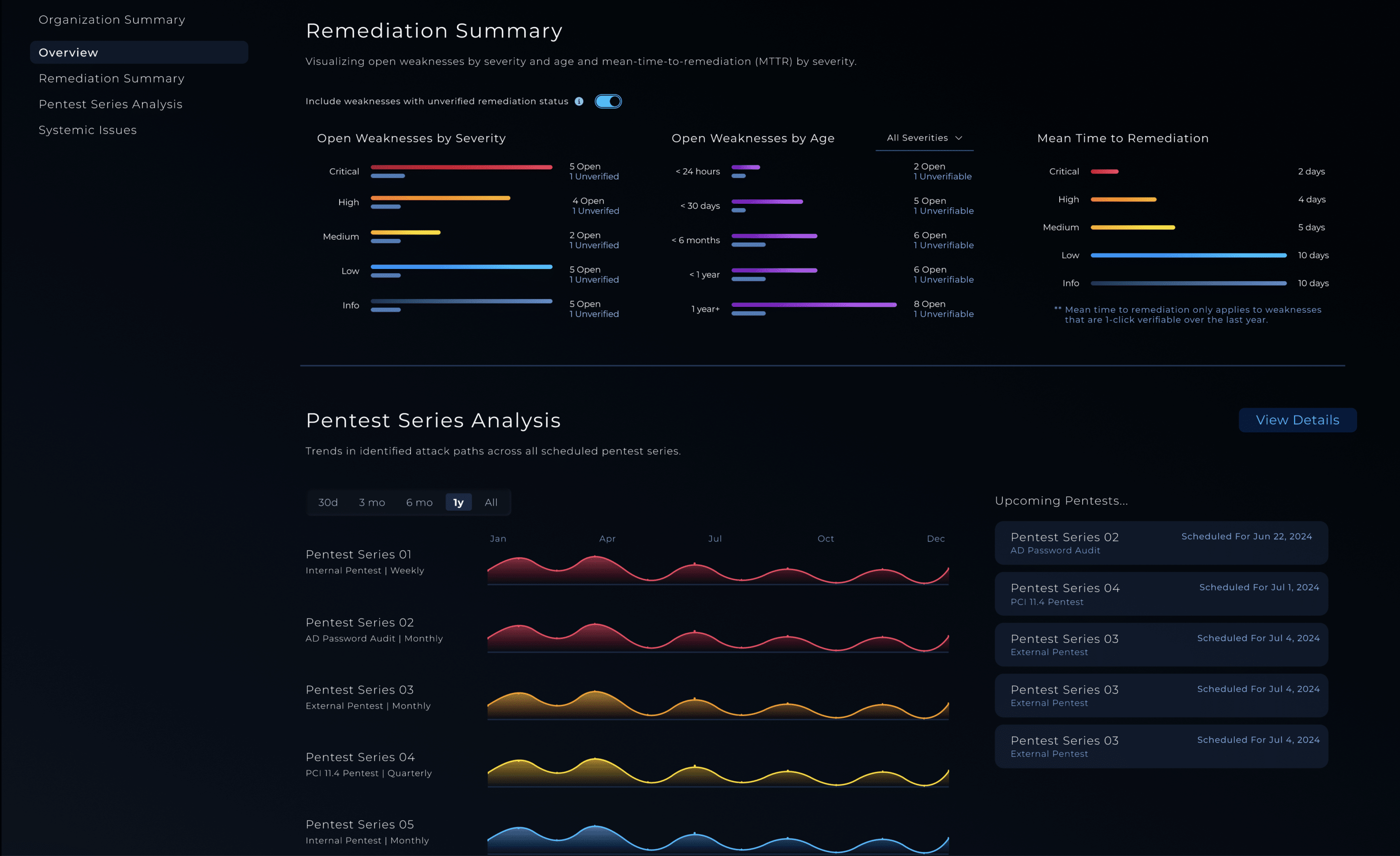
The NodeZero® platform empowers your organization to reduce your security risks by autonomously finding exploitable weaknesses in your network, giving you detailed guidance around how to priortize and fix them, and having you immediately verify that your fixes are effective.
Recognized By
如有侵权请联系:admin#unsafe.sh