
A year ago, having an AI writing assistant in your editor felt like a premium differentiator. Today, 2026-7-9 20:27:18 Author: hackernoon.com(查看原文) 阅读量:25 收藏
A year ago, having an AI writing assistant in your editor felt like a premium differentiator. Today, it's table stakes. In 2026, if a WYSIWYG editor doesn't ship with some form of AI assist, it's already behind. The question has stopped being "does this editor have AI?" and started being "how does it actually work, and what does that mean for my team?"
That shift reveals a real tension: some editors bundle AI tightly into their platform, billing it separately and locking you into a specific model or provider. Others take a more open approach, giving you the hooks to bring your own API keys, choose your own model, and keep your data where it belongs.
This article is for developers and product teams who are either choosing an editor for the first time or re-evaluating what they're already using. We'll look at what "AI assist" actually means inside a WYSIWYG editor, walk through how the major players implement it, and give you a clear framework for choosing what fits your situation. The verdict, spoiler-free: flexibility, pricing model, and data control are what separate the good implementations from the great ones.
Key Takeaways
- In 2026, nearly every major WYSIWYG editor ships some form of AI; the real differentiator is how it's implemented.
- The biggest divide is between proprietary, locked-in AI and flexible "bring your own provider" models like Froala's.
- Editors like TinyMCE and TipTap meter AI separately or tie it to their own platforms, which affects cost at scale.
- Open-source editors (Quill, Lexical, Slate) offer no native AI; you're responsible for the full integration.
- Data control and provider flexibility matter most for regulated industries and teams with security requirements.
What "AI Assist" Actually Means Inside an Editor
Before comparing editors, it helps to be precise about what we're even evaluating.
In-editor AI assist typically covers a predictable set of capabilities: generating content from a prompt, rewriting or paraphrasing existing text, adjusting tone (formal, casual, persuasive), summarizing long passages, translating between languages, and sometimes offering a chat-style interface where users can ask freeform questions inside the editor context. These aren't novel features; what varies dramatically is how they're plumbed in.
There are three broad implementation patterns you'll encounter:
- Built-in AI means the editor ships with AI features ready to use. You configure an API key (yours or the vendor's), and AI toolbar buttons appear. The experience is polished and opinionated.
- Bolt-on AI means AI is added as a separate plugin or add-on, sometimes from a third party, sometimes from the vendor, but as a paid tier on top of the base editor. It works, but it often feels like a seam.
- Roll-your-own (no native AI) means the editor provides no AI layer at all. You're integrating AI yourself using the editor's extension API. Maximum control, maximum engineering time.
Why does in-editor AI matter? Because context-switching kills writing flow. When a user has to leave the editor, open ChatGPT, paste text, get a result, and paste it back, that's friction that compounds across a content team. An editor that handles AI natively keeps the user in the creative loop.
For this article, we'll evaluate editors across six criteria: AI capabilities, provider lock-in, pricing model, setup effort, data and security control, and license model.
The Contenders: AI Editors Compared at a Glance
The landscape breaks into two groups: editors with native AI support and editors that leave AI entirely to you.
The editors with native AI are Froala, TinyMCE, CKEditor 5, and TipTap. Each has shipped an AI feature, but the implementation philosophy differs significantly. The no-native-AI group includes Quill, Lexical, Slate, and ProseMirror, all capable editors with distinct strengths, but requiring you to build your own AI layer from scratch.
Here's how they compare across the key criteria:
Editor | AI Feature Name | What the AI Does | Provider Lock-in? | AI Cost Model | Setup Effort | Self-hosting / Data Control | License Model |
Froala | Generate, rewrite, tone adjust, translate, AI chat popup | No – BYO model via aiAssistRequest callback | AI Assist included; pay only your AI provider (OpenAI, Claude, Gemini, self-hosted, etc.) | Low – callback-based config | Full – keys server-side, self-hosted models supported | Commercial (perpetual + subscription) | |
TinyMCE | AI Assistant | AI writing help, image alt-text generation | Yes – tied to TinyMCE's API/stack | Paid AI add-on (managed AI service) | Low – plug-and-play within their ecosystem | Partial – depends on their cloud routing | GPL v2+ (open source) + Commercial |
CKEditor 5 | AI Assistant | AI commands and suggestions inside the editor | Partial – limited provider flexibility | Subscription + AI credits with usage-based overages | Medium – commercial licensing setup required | Yes – enterprise self-hosting available | GPL 2+ / Commercial (dual license) |
TipTap | AI Autocomplete + Commands | AI autocomplete, slash commands, text generation | Yes – requires TipTap Platform | Platform subscription + usage/document-based AI pricing | High – headless; you build the UI layer | Yes – self-hosting available | MIT (core) + Commercial Platform |
Quill | None (DIY) | No native AI – integrate manually via extensions | N/A | Bring your own AI provider | Very High – full custom AI build required | Yes | BSD 3-Clause |
Lexical | None (DIY) | No native AI – integrate manually via plugins | N/A | Bring your own AI provider | Very High – full custom AI build required | Yes | MIT |
Slate | None (DIY) | No native AI – integrate manually | N/A | Bring your own AI provider | Very High – full custom AI build required | Yes | MIT |
ProseMirror | None (DIY) | No native AI – integrate manually via extensions | N/A | Bring your own AI provider | Very High – full custom AI build required | Yes | MIT (core packages) |
Read this table from left to right: start with the AI feature name, then focus on the Provider Lock-in and Pricing Model columns, which are where the biggest long-term decisions live. Self-hosting availability matters most if you operate in a regulated or data-sensitive environment.
The table makes the split clear: Froala is the only editor in the native-AI group where provider lock-in is explicitly absent by design. The others either tie you to their stack or meter AI usage on top of your base subscription.
Froala AI Assist: Bring Your Own AI
Froala's AI Assist, introduced in v5.1, takes a deliberately open approach to AI integration, and that openness is its main selling point.
The plugin adds a set of toolbar controls: an AI chat popup, tone adjustment buttons, translation options, and an "Ask Anything" prompt where users can type freeform instructions directly in the editor interface. From a user perspective, it looks and feels like any other editor feature. From a developer perspective, what's underneath is what sets it apart.
The core of Froala's AI integration is the aiAssistRequest callback. Instead of routing requests to a hardcoded endpoint, Froala calls this function, which you define, on every AI action. That means you decide where the request goes, which model handles it, how it's logged, and whether it gets cached or rate-limited. Froala doesn't care whether you're calling OpenAI, Anthropic's Claude, Google Gemini, DeepSeek, or a self-hosted model running on your own infrastructure. The callback is provider-agnostic by design.
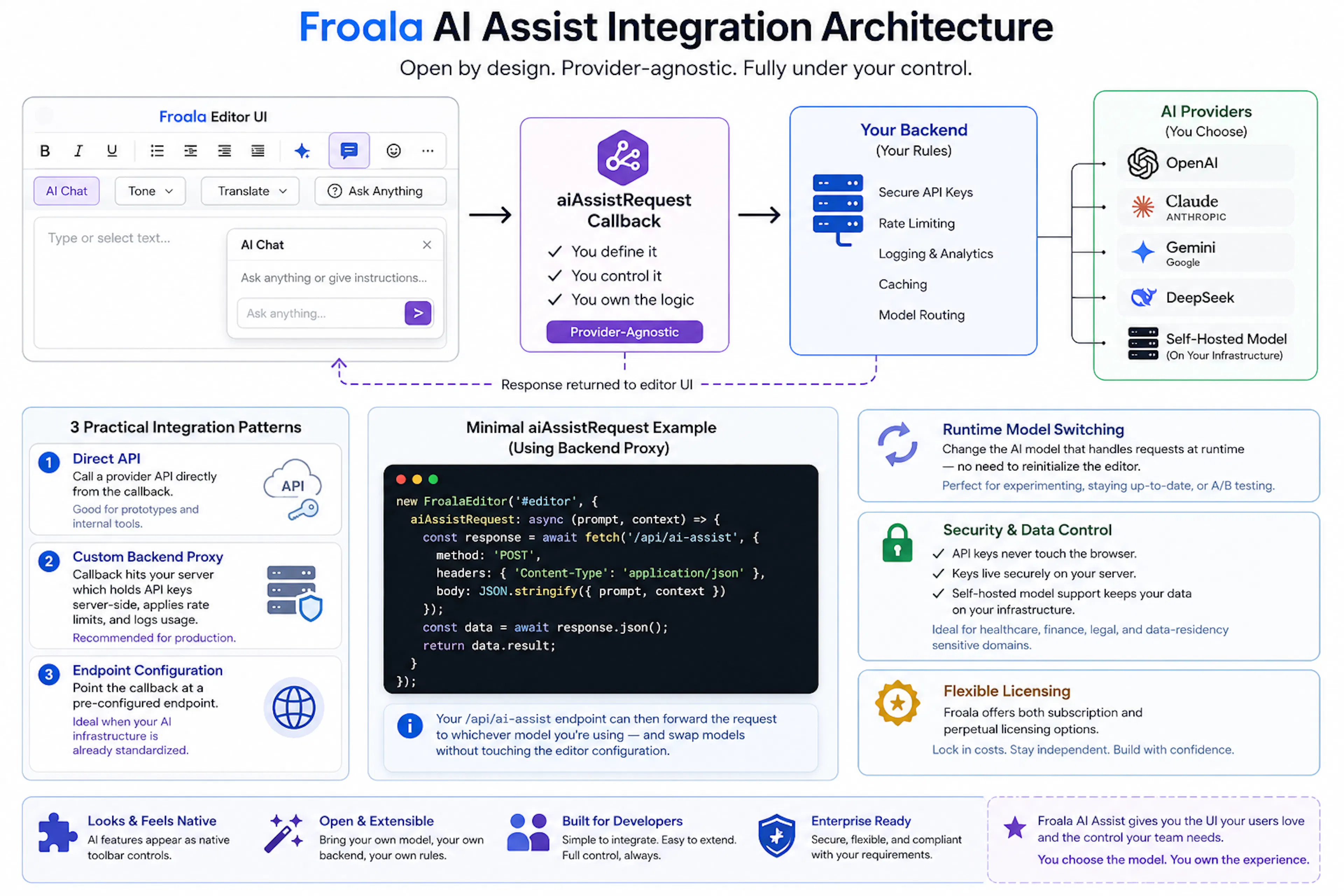
The callback sits between the editor UI and your chosen AI provider, giving your backend full control over routing, logging, and key management.
There are three practical integration patterns:
- Direct API: Call a provider API directly from the callback. Good for prototypes and internal tools where you're not worried about exposing keys.
- Custom backend proxy: The callback hits your own server, which holds API keys server-side, applies rate limits, and logs usage. This is the recommended production pattern.
- Endpoint configuration: Point the callback at a pre-configured endpoint, useful when your AI infrastructure is already standardized.
Here's a minimal example of the aiAssistRequest setup using a backend proxy:
new FroalaEditor('#editor', {
  aiAssistRequest: async (prompt, context) => {
    const response = await fetch('/api/ai-assist', {
      method: 'POST',
      headers: { 'Content-Type': 'application/json' },
      body: JSON.stringify({ prompt, context })
    });
    const data = await response.json();
    return data.result;
  }
});
Your /api/ai-assist endpoint can then forward the request to whichever model you're using, and swap models without touching the editor configuration.
That last point is worth pausing on: Froala supports runtime model switching. You can change which AI model handles requests without reinitialising the editor instance. For teams experimenting with newer models or running A/B tests on output quality, this is a meaningful practical advantage.
On the security and data control side, Froala's approach is straightforward: API keys never touch the browser. They live on your server, in your environment. If you're operating in healthcare, finance, legal, or any domain with data residency requirements, self-hosted model support means your content never has to leave your infrastructure at all.
Froala's licensing is also worth noting; it offers both subscription and perpetual licensing options, which matters for teams that need to lock in costs or operate in environments that restrict SaaS dependencies.
TinyMCE AI Assistant
TinyMCE has one of the largest install bases of any WYSIWYG editor, and its AI Assistant feature reflects that maturity. It covers the core use cases well: AI-powered writing help and image alt-text generation, both surfaced cleanly inside the familiar TinyMCE interface.
The documentation is solid, the ecosystem is broad, and if your team is already on TinyMCE Cloud, the learning curve for the AI add-on is low.
The trade-off is structural. The AI Assistant is a separate paid add-on layered on top of the base TinyMCE subscription, meaning you're paying for the editor and then paying again for AI access, with the AI usage metered separately. You're also tied to TinyMCE's AI stack: the provider routing, the pricing model, and the feature roadmap all sit outside your control.
For teams already committed to the TinyMCE platform and comfortable with its billing model, this works. For teams evaluating from scratch, the locked-in provider and separate metering are real constraints to weigh.
CKEditor 5 AI Assistant
CKEditor 5 is a strong enterprise play, and its AI Assistant feature is no exception. AI commands and suggestions are integrated into the editor flow, and the overall package leans into CKEditor's traditional strengths: collaboration features, compliance tooling, and robust documentation.
The AI capabilities here are solid but still maturing relative to the editor's core features. What makes CKEditor 5 attractive for enterprise teams, deep permissions, real-time collaboration, and a heavy feature set, also makes it expensive at scale, particularly once you factor in commercial licensing overhead.
Provider lock-in is partial: CKEditor's AI connects to a set of supported providers, but the flexibility is more limited than a fully callback-based model. For large organisations with standardised AI infrastructure, that partial openness may or may not align with existing tooling.
TipTap AI
TipTap takes a headless approach to editing; it ships the editor logic and extension architecture without an opinionated UI. Its AI layer follows the same philosophy: AI autocomplete and commands are available, but you're building the interface that surfaces them to users.
That's powerful in the right hands. If your team has strong frontend engineering capacity and wants complete UI control, TipTap's AI extensions give you a clean foundation. The architecture is modern, and the extension API is well-designed.
The practical considerations are worth understanding clearly. TipTap AI sits behind the TipTap Platform, a paid tier with usage-based and document-based pricing that scales with your content volume. The more you use it, the more it costs, and the "headless" nature means more engineering hours go into building and maintaining the AI experience. For teams without that bandwidth, the flexibility that makes TipTap attractive can also make it expensive in non-obvious ways.
The "No Native AI" Group: Quill, Lexical, Slate, ProseMirror
Quill, Lexical, Slate, and ProseMirror deserve mention because they're widely used and frequently come up in editor comparisons. But they share one critical characteristic in this context: none of them ship native AI features.
That's not a knock on any of them. These editors have real strengths; they're free and open-source, lightweight (or extremely customizable), and backed by active communities. ProseMirror powers some of the most demanding editing experiences on the web. Lexical comes from Meta and has serious engineering behind it.
The trade-off is that "integrate AI yourself" is genuinely expensive to do well. You're not just wiring up an API call; you're handling paste behaviour, maintaining accessibility, managing editor state during async operations, and dealing with edge cases that purpose-built AI integrations have already solved. The engineering investment is significant, and it's ongoing maintenance, not a one-time build.
This group is best understood as the baseline: they make clear what you get when AI is properly integrated vs. when you're doing it yourself.
How to Choose: Pick the Right AI Editor for Your Situation
No editor is the right choice in every context. The right question is which trade-offs matter most to your team.
Choose Froala if you want native AI that doesn't lock you into a specific provider or pricing model, data control is a hard requirement (especially in regulated industries), you want to swap AI models at runtime without editor reconfiguration, or perpetual licensing is important for your procurement process.
Choose TinyMCE if your team is already deep in the TinyMCE ecosystem, community maturity and documentation breadth are high priorities, and you're comfortable with separate AI billing as part of your tooling budget.
Choose TipTap if you need a fully headless editor core with maximum UI flexibility, your frontend team has the capacity to build and own the AI experience, and usage-based pricing works for your traffic patterns.
Choose a no-native-AI editor (Quill, Lexical, Slate, ProseMirror) if zero licensing cost is a firm constraint, your engineering team can absorb the long-term maintenance of a custom AI integration, and minimal footprint or maximum extensibility is the primary driver.
The thread connecting these choices: the more your team values flexibility, cost predictability, and data control, the more the open, callback-based approach in Froala's design makes sense. The more you value ecosystem maturity and opinionated tooling, the more TinyMCE or CKEditor 5 will feel natural.
Conclusion
In 2026, the smartest AI assist in a WYSIWYG editor isn't the one with the most features on a marketing page; it's the one that fits how your team actually works without creating new dependencies you'll regret later.
The central tension we laid out at the start holds throughout this comparison: proprietary, locked-in AI trades short-term convenience for long-term constraint. Provider-agnostic AI trades some setup effort for lasting flexibility. As models improve and pricing shifts, the teams that built on open architectures will adapt more easily than the ones locked into a vendor's roadmap.
Froala's AI Assist is designed around that flexibility. The aiAssistRequest callback gives you the routing; the keys stay server-side, self-hosted models are fully supported, and you can switch providers without touching your editor configuration. For teams that care about where their content goes and what it costs to process it, that's not a minor implementation detail; it's the whole point.
如有侵权请联系:admin#unsafe.sh