
You've probably watched product teams launch secure messaging, modern e-signature tools, and sleek p 2026-7-17 19:25:13 Author: hackernoon.com(查看原文) 阅读量:9 收藏
You've probably watched product teams launch secure messaging, modern e-signature tools, and sleek portal uploads. They ship the code, celebrate the release, and then discover that a critical prior authorization, claims packet, or signed disclosure still goes out through an analog machine.
That gap between shiny software and messy real-world operations is stubborn. Plenty of organizations still rely on exchanging documents with external parties that don't use the same modern systems.
A robust
The TL;DR:
- External Stack Realities: Fax persists because counterparties operate entirely outside your internal software ecosystem.
- Programmable Delivery: A fax API replaces manual uploads and physical servers with programmatic document routing.
- Observability Wins: Audit trails, webhook callbacks, and deterministic delivery receipts matter far more than digital-versus-analog ideological debates.
- Smart Architecture: Technical decisions hinge on centralization, compliance controls, and engineering velocity.
Why Fax Still Shows Up in “Modern” Workflows
Interoperability Is Improving, but Unevenly
Federal efforts push industries toward seamless data sharing, but progress remains heavily fragmented across regions and specialties. The reality is that
While larger hospital networks adopt FHIR interfaces quickly, smaller clinics, rural providers, and specialized facilities simply lack the engineering budgets to overhaul their internal infrastructure overnight. Consequently, the U.S. healthcare industry still exchanges over 9 billion fax pages annually. If you build a backend that speaks exclusively to ultra-modern endpoints, you cut off a massive chunk of your operational network.
External Parties Dictate Workflow Reality
The slowest-moving endpoint in any multi-party transaction defines the entire technical workflow. You might run a fully cloud-native, event-driven infrastructure, but if a partner law firm, independent pharmacy, or mortgage processing agent prefers older protocols, you have to accommodate them.
The market reflects this persistence: the global online fax market is projected to reach
What a Fax API Solves
It Removes the Human Middleware
Manual document handling turns highly paid staff into human middleware between disconnected applications. Workers burn hours printing PDFs, walking to machines, keying in recipient numbers, and squinting at paper confirmation sheets. Shared digital fax inboxes create operational blind spots where ownership and status remain unclear.
Moving to a programmable layer completely changes that workflow. Automating these steps removes the need to manually rename attachments or hand-index received files into patient or customer records. Staff can focus on exceptions and complex problem-solving rather than serving as a manual data transport layer, while engineering teams can replace unpredictable human actions with deterministic, automated web requests.
It Turns Document Exchange into a System Workflow
Replacing physical machines with digital endpoints turns chaotic document sharing into an observable, programmable pipeline. Developers can trigger outbound transmissions directly from an application in response to changes in the database state, such as a patient completing an intake form.
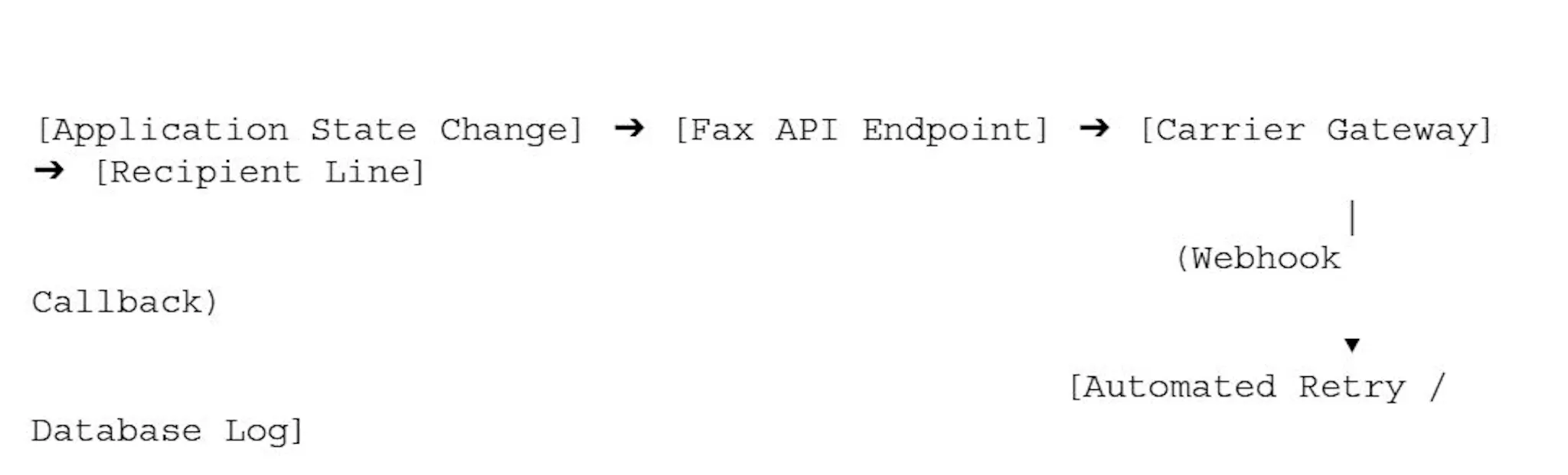
When a transmission fails due to a busy signal, the automated layer queues an immediate retry based on your custom backoff logic without manual intervention. Inbound files drop straight into secure object storage, triggering an event notification that tells the application to parse and process the payload instantly. This completely eliminates the risk of a critical document sitting unread in a physical tray over the weekend.
It Improves Observability
Traditional telecommunication infrastructure provides notoriously poor visibility, leaving engineering and support teams blind when a critical transmission fails. A programmable messaging layer fixes this by providing detailed metadata on every interaction: who sent the payload, when the transmission occurred, and the exact error code returned by the receiving station.
By implementing programmable receipts and timeline logs, developers gain immediate insight into system health and partner responsiveness. You no longer have to guess whether a document arrived; you query the endpoint and parse the specific callback event.
### Signs You've Outgrown Manual Faxing:* Staff still print or manually upload files to send routine documents.* Shared inboxes obscure document ownership and current processing status.* Your fax server requires specialized on-prem maintenance or aging telephony infrastructure.* Your core application cannot trigger, track, or confirm delivery from inside the primary user workflow.* Compliance reviews lack granular user-level traceability and automated timestamps.
Fax API vs. Alternative Protocols
Don’t Treat This as a Winner-Take-All Stack
Most mature organizations use several communication channels depending on the counterparty and the sensitivity of the data. The real design challenge is determining which channel belongs to which workflow step, rather than forcing a single technology to handle everything. You build a stronger platform by supporting market realities rather than fighting them.
|
Communication Channel |
Best For |
Weaknesses |
Auditability |
Implementation Effort |
|---|---|---|---|---|
|
|
Fast, ad hoc communication. |
Attachment sprawl, weak structured delivery, inconsistent receipt confirmation. |
Low to Moderate |
Low |
|
Secure Portal |
Controlled exchange with known, highly engaged users. |
Requires both parties to maintain active accounts and adopt a proprietary UI. |
High |
Moderate to High |
|
E-Sign Tools |
Formal signature and execution workflows. |
Not designed as a universal transport layer for bulk document types. |
Moderate to High |
Moderate |
|
Legacy Fax Server |
On-premises environments with pre-existing setups. |
Heavy hardware/telephony admin overhead, brittle maintenance cycles. |
Moderate |
High |
|
Fax API |
Embedded, automated document exchange with arbitrary external endpoints. |
Delivery success still depends on the uptime of external receiving machines. |
High |
Moderate |
Why Regulated Teams Care About Fax APIs
Compliance Is About Controls, Not Buzzwords
Regulated industries require strict access controls, encryption at rest, encryption in transit, and detailed user activity logging. Using an older communication format does not absolve you from modern security audits. In fact, __HIPAA civil monetary penalties__are indexed for inflation annually and can cap out at over $2.1 million per year for willful neglect.
> **Security Insight:** Data breaches within health systems continue to account for the vast majority of reported healthcare exposures. Programmable cloud endpoints centralize these security controls, letting platform engineering teams enforce uniform TLS and storage encryption standards across the entire document lifecycle. Business Associate Agreements (BAAs) also get easier to manage when you contract with a single, thoroughly vetted cloud provider instead of maintaining fragmented physical infrastructure across dozens of satellite offices.
Auditability Is a Product Requirement
Building applications for healthcare or finance means treating auditability as a primary feature, not an afterthought requested by the legal department. Every referral proof, prior authorization dispute, or signed disclosure record requires a clear chain of custody.
With regulators expanding scrutiny under TEFCA (Trusted Exchange Framework and Common Agreement) frameworks, you cannot afford to lose formal notices in a shared folder. A programmable layer ensures every lifecycle event generates an immutable log entry. This programmatic visibility protects the business from operational disputes and regulatory fines tied to missing documentation.
Build vs. Buy: The Decision Framework for Technical Buyers
Evaluating the Cost of Legacy Abstractions
Maintaining on-premises fax hardware or legacy servers forces your IT department to babysit aging telephony infrastructure, manage SIP trunks, and configure complex disaster recovery plans. These machines lack modern webhook support, making it incredibly difficult for developers to build responsive, event-driven applications.
A cloud-based abstraction layer hands the telephony headache to a specialized vendor while giving developers clean REST web services. Your infrastructure team can then focus on core business logic instead of diagnosing dropped analog phone lines.
Key Evaluation Parameters for Technical Buyers
When selecting a provider, look past marketing claims and evaluate developer ergonomics:
- Endpoint Capabilities: Verify that the vendor offers robust web services for sending and receiving messages, as well as clean programmatic provisioning of local or toll-free numbers.
- Webhook Reliability: The provider must guarantee structured status updates when documents are transmitted, delayed, or failed.
- Developer Tooling: Prioritize platforms that provide isolated sandbox environments, comprehensive code samples, transparent uptime SLAs, and clean developer documentation.
Core Flow Architecture
A resilient architecture begins when the primary application generates a document and stores it securely in an object storage bucket. The application then issues a secure POST request to the cloud provider, referencing the file URL, recipient information, and metadata tags.
{
    "documentId": "referral_48291",
    "recipientFax": "+15555550199",
    "callbackUrl": "https://app.example.com/webhooks/fax-status",
    "tags": {
        "patientId": "P-10283",
        "workflow": "referral"
    }
}
Critical Implementation Details
- Idempotency Safeguards: Implement strict idempotency keys to prevent a network hiccup or timeout from double-firing the same financial or medical transaction.
- Webhook Verification: Ensure your application validates incoming webhook signatures to stop malicious actors from spoofing successful delivery events.
- PHI and PII Stripping: Configure monitoring and application logging tools to explicitly strip out protected health information and personally identifiable information before writing to application logs.
The Strategic Reality
True modernization is about eliminating manual operational friction within your own organization, not about waiting for external partners to suddenly upgrade their entire IT infrastructure. The strongest software architectures embrace the communication channels that are highly deployable today, even if they look less fashionable than cutting-edge alternatives.
By treating fax as a reliable, programmable transport layer within a broader omni-channel messaging strategy, engineering teams build resilient, pragmatic software that solves real-world operational challenges right now.
如有侵权请联系:admin#unsafe.sh