
Modern enterprise codebases have become highly complex, rendering traditional quality assurance meth 2026-7-18 19:32:48 Author: hackernoon.com(查看原文) 阅读量:11 收藏
Modern enterprise codebases have become highly complex, rendering traditional quality assurance methods inadequate. As systems scale and interconnect, undetected defects and slow feedback jeopardize reliability and business outcomes.
Code simulation revolutionizes quality assurance by moving beyond reactive testing to actively modeling systems at scale. In today’s demanding software environments, leveraging AI-driven code simulation is essential for mitigating risks and speeding up delivery.
In this post, we look at the evolution of quality assurance through code simulation, highlight the key techniques transforming the field, and demonstrate how this approach empowers organizations to uncover elusive defects early, minimize manual work, and lead the way in AI-enhanced software reliability.
Why standard types of testing no longer suffice
Standard software testing methods—unit, integration, and end-to-end—each operate at distinct layers of coverage, requiring teams to constantly balance granularity against practicality.
Unit tests
Unit tests target the smallest elements, like individual functions or classes, checking them in isolation for correctness and catching low-level bugs early. However, their specificity means they offer little clarity on how components interact in real-world scenarios.
Integration tests
Integration tests move beyond components, verifying that multiple modules, services, or APIs work together as intended. While these reveal interface problems and data flow errors, they’re often challenging to set up, and rarely replicate the full complexity of the production environment.
End-to-end tests
End-to-end tests simulate complete user workflows—for example, from login through checkout—testing the system for business and usability issues. These broad tests are resource-intensive and slow to maintain, making comprehensive scenario coverage nearly impossible.
As a result, teams face a coverage paradox: unit tests are too granular to catch faults that only emerge through system interactions, while integration and end-to-end tests are so broad and state-dependent that their scope is inherently limited. This gap exposes the business to risks that these types of testing can’t reliably prevent, as an exhaustive system context is rarely captured across the full spectrum of testing.
The code complexity crisis: Why traditional QA can’t keep up
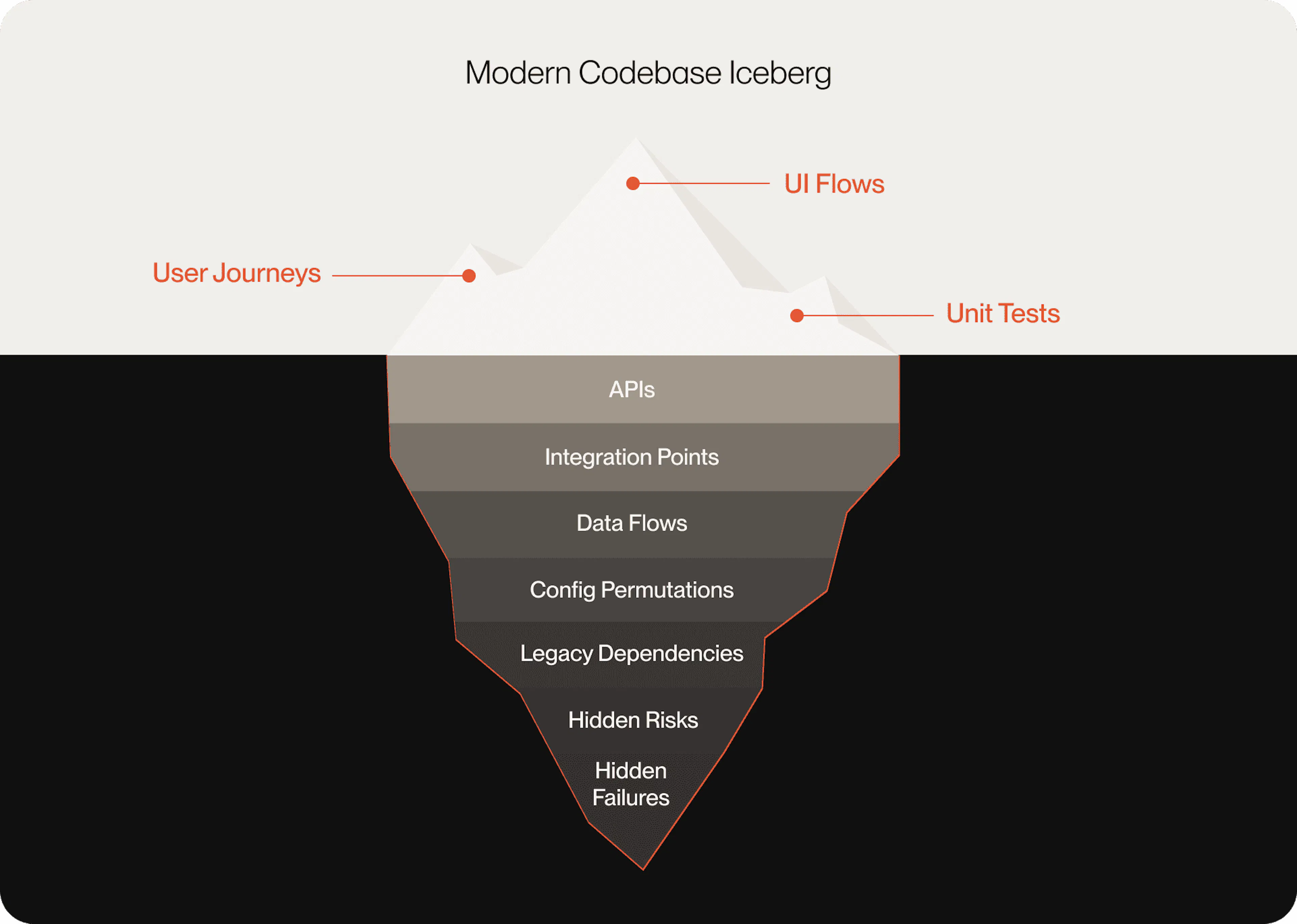
Codebases have exploded in scale and interconnectedness, driven by rapid feature releases, legacy system integrations, and aggressive growth—creating complexity that traditional QA can’t keep up with.
As code and system interactions grow exponentially, traditional QA’s focus on predefined test cases falls short. It struggles to anticipate the unforeseen ways components can behave when combined, leaving significant gaps in coverage that put software reliability at risk.
Because it focuses only on known requirements, QA often misses defects caused by unexpected interactions between interconnected systems, allowing issues to reach customers. These weaknesses expose systemic flaws in legacy QA workflows:
- Slow, fragmented feedback loops: Manual handoffs between people, documents, and systems lead to miscommunication, outdated information, and delayed defect detection—letting bugs spread deeper into production.
- Environment overload: At scale, building and maintaining test environments becomes a heavy lift. When they’re incomplete or misconfigured, critical interactions and edge cases go untested, raising the risk of production failures.
These bottlenecks drain QA resources, slow release cycles, and increase reliability risks. Code simulation addresses these challenges by transforming QA from reactive testing to proactive, system-level quality assessment at scale.
What is code simulation? A discipline for proactive quality
Instead of relying solely on scripted or manual tests, code simulation represents a fundamental shift in how organizations approach software quality assurance.
At its core, code simulation enables teams to explore the behavior of software systems under a wide array of real-world conditions, uncovering vulnerabilities and failure modes before they manifest in production. This shift from reactive testing to proactive exploration empowers teams to validate complex interactions that traditional methods often overlook.
By integrating data from telemetry, user sessions, and code changes, code simulation builds a dynamic, living model of the system’s behavior. This allows continuous assessment of how new features or updates might ripple through the software ecosystem—enabling earlier intervention and more informed decision-making.
Code simulation uses computer models to replicate and analyze the behavior of interconnected software systems before deployment. By applying techniques such as event‑driven simulation, stochastic models, agent‑based modeling, or AI‑driven analysis, it models thousands of possible scenarios—surfacing potential failures, hidden defects, and risky edge cases that escape detection until production.
Code simulation delivers several core benefits for modern software teams:
- Early risk detection: Identifies regressions, integration issues, and failure states before they impact customers, even those beyond institutional knowledge.
- Greater efficiency: Dramatically reduces the manual, repetitive QA work needed to uncover hidden risks.
- Real-world focus: Prioritizes problems tied to actual customer behavior and live telemetry, not just theoretical defects.
Code simulation isn’t just auto‑generating tests, running your full production environment, or a form of UI automation. It’s a proactive, system‑level modeling approach that delivers deep insight without the heavy lift of building full production mirrors.
Why code simulation outpaces testing, static analysis, and monitoring
To understand why code simulation represents a transformative advance for enterprise software quality, it helps to examine how it differs fundamentally from traditional QA methods.
Limitations of traditional QA methods
Each legacy approach was designed to detect specific classes of problems, yet they each face inherent limitations when dealing with the complexity and scale of modern software systems.
- Traditional testing checks planned scenarios and known risks, often missing the unpredictable failures that emerge from system interactions. As a result, hidden bugs are typically only discovered after they impact customers, causing downtime, late fixes, and business risk.
- Static analysis scans code for problems without running it. Without runtime context—how components behave when everything’s connected—performance bottlenecks, runtime errors, and dependency‑driven failures often slip by until production.
- Monitoring waits for problems to appear in live environments. By the time alerts fire, customers are already affected, negatively impacting the user experience, brand reputation, and bottom line.
Code simulation breaks these constraints by proactively and comprehensively modeling interconnected system behaviors and potential failure points before they impact users, enabling teams to reduce manual effort and catch hidden defects earlier in the development lifecycle.
How code simulation fills these gaps
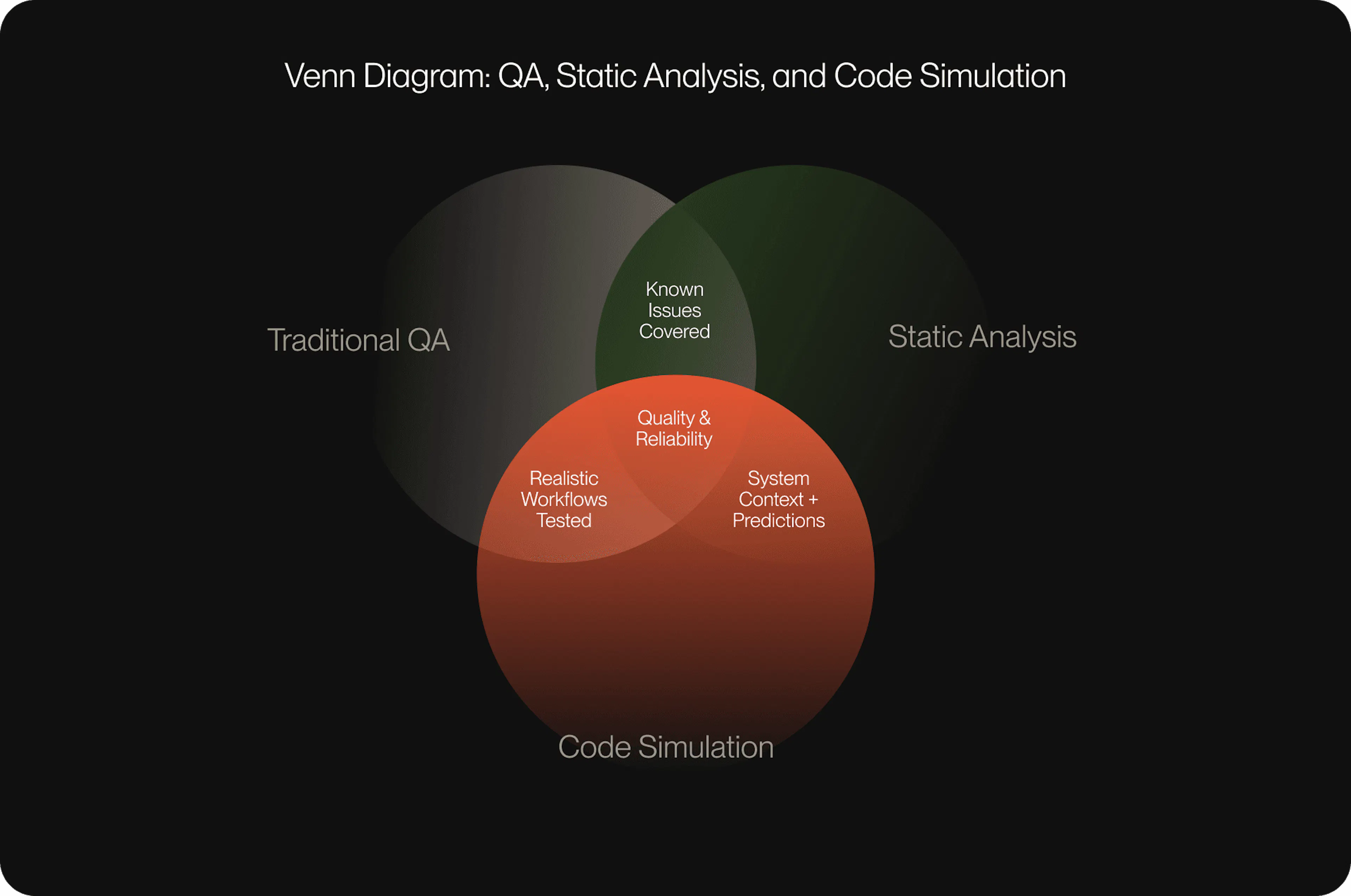
Code simulation enhances and complements traditional QA methods by proactively uncovering hidden risks, providing system-level runtime context, and enabling early failure detection—empowering organizations to manage complexity, accelerate delivery, and maintain software quality at scale.
Quality assurance method
Timing of action
Scope and focus
Key limitations
Business impact
Traditional testing
Reactive
Validates known scenarios
Human effort, scripting
Test infra required
Static analysis
Local code reasoning
Finds code smells/bugs
No system context
No runtime behavior
Monitoring
Detects post-release issues
Needs real traffic/users
Customers still feel the pain first
High volume of noisy signals
Code simulation
Proactive, system-wide
Explores unknown scenarios
Models risk before deployment
Direct business value
Together, these capabilities transform QA from a reactive safeguard into a proactive risk management strategy.
The four key code simulation methods: Definitions, use cases, and benefits
Modern software development creates complexity that outpaces traditional testing. Teams now rely on complementary simulation methods—Discrete-event, Monte Carlo, Agent-based, and AI-driven simulation—to proactively uncover hidden risks and optimize system performance. By combining these approaches, engineers can predict and validate system behaviors under real-world conditions, addressing critical gaps that old QA practices miss.
Discrete-event simulation
Discrete-event simulation (DES) models systems as sequences of distinct events—like code commits, automated build jobs, running test suites, artifact deployment, and environment provisioning—that change system states over time.
Companies use DES tools like Simio or Arena to simulate these workflows, capturing how each event triggers changes. For example, queuing build or test tasks when resources are busy, or triggering deployment steps once prior tasks are complete.
By modeling workflows step-by-step, DES helps teams identify bottlenecks and predict delays in software delivery pipelines. This detailed process insight enables proactive adjustments to resource allocation, scheduling, and automation to improve efficiency and reduce downtime. However, building accurate, large-scale models is resource and time-intensive, requiring specialized expertise to keep pace with evolving systems.
Monte Carlo simulation
Monte Carlo simulation captures uncertainty by sampling probability distributions to forecast outcome ranges. In software engineering, it quantifies risk and sets realistic service level objectives (SLOs) under variable conditions, such as assessing the likelihood of performance slowdowns or forecasting failure rates under unpredictable load.
The method is also widely used in finance, where investment professionals and advisors regularly simulate thousands of possible price scenarios to estimate Value‑at‑Risk (VaR), forecast retirement portfolio outcomes, and guide asset allocation decisions. These simulations are central to financial planning and regulatory risk assessment.
In software contexts, Monte Carlo simulation helps teams move beyond single-point predictions by considering a wide range of potential outcomes. This supports more resilient capacity planning, informed decision-making, and realistic expectations around system performance under diverse conditions.
The effectiveness of the Monte Carlo method depends heavily on the quality of input data and assumptions, and high computational costs limit scalability for detailed system modeling.
Agent-based simulation
Agent-based simulation models autonomous entities and their interactions to explore complex, emergent system behaviors. This approach excels at capturing how individual behaviors and local interactions produce system-wide effects, helping teams understand dynamics that traditional analysis might miss.
For example, companies like ViaSim Solutions (Texas) and SimBLOX (Maryland) have used agent-based simulation to address real-world challenges in software project management and team productivity. In one case, they modeled a software development project by representing experienced developers and trainees as distinct agents with different behaviors and interactions. The simulation captured states, such as coding, mentoring, and communication, enabling more accurate forecasting of project timelines, resource allocation, and training impacts.
By reflecting real-world variability in human and system actions, agent-based models reveal bottlenecks, communication patterns, and emergent risks in complex projects.
While this approach readily captures emergent behaviors and interactions within highly interdependent, multi-part systems, agent-based models can become computationally intensive and difficult to scale when simulating large populations or many interacting agents.
AI-driven simulation
AI-driven simulation uses machine learning and data-driven models to predict unknown failure modes, simulate interactions at scale, and identify risks before deployment—dramatically improving coverage, speed, and defect detection.
By proactively modeling system behaviors and generating test scenarios from real-world data, AI-driven simulation overcomes the limitations of traditional QA methods. In SaaS environments, it identifies hidden defect paths from code changes and telemetry, accelerating test cycles and reducing manual effort.
PlayerZero’s Sim-1 technology serves as a prime example of AI-driven simulation in practice. It automatically learns from real production data to model how code executes across distributed systems, enabling teams to surface bugs before deployment and improve test coverage with less manual overhead.
While effective adoption often relies on high-quality data and thoughtful integration, modern solutions like PlayerZero are specifically designed to make this process far more seamless and accessible for teams.
In real-world applications, most advanced teams don’t rely on a single simulation technique. Combining these approaches often produces richer, more accurate insights:
- DES can be combined with agent-based models to simulate event-driven workflows with interacting agents.
- Monte Carlo methods can add probabilistic variation to both DES and agent-based simulations, quantifying risk and uncertainty.
- AI-driven simulation can integrate all three elements, learning from data to enhance scenario generation, refine models, and automate the discovery of critical edge cases.
With software complexity increasing and release schedules tightening, AI-driven code simulation is rapidly becoming the industry’s catalyst for faster, safer deployments—shifting QA from a blocking step into a strategic advantage that uncovers hidden risks and scales effortlessly.
Why AI-driven code simulation is the future—and why enterprises are using it now
With the pressure of rapid development cycles, enterprises are adopting AI-driven simulation to meet the urgent demand for faster feedback and higher software quality.
Rather than relying on static testing or manual oversight, AI-driven simulation creates a continuously evolving, accurate model of system performance and risks. This helps teams keep pace with constant updates, adapt to new failure modes, and maintain confidence in software releases—even as complexity increases.
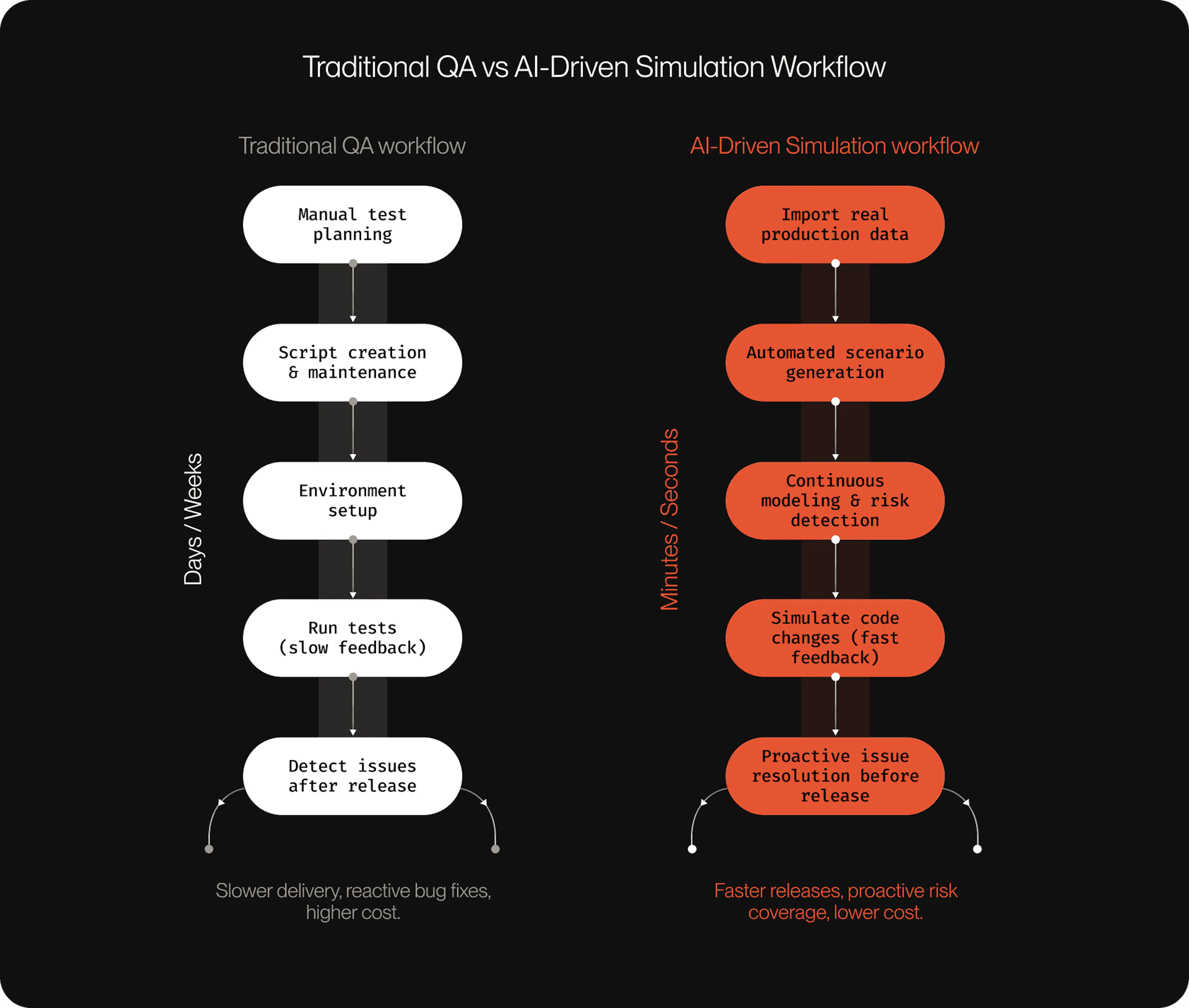
By automating scenario generation from real production data, these tools make QA faster, more thorough, and less dependent on manual effort—enabling teams to spend less time scripting and more time shipping.
This transformation frees QA and developers from manual maintenance, letting organizations focus on innovation, tackling technical debt, and enhancing reliability:
- Engineering and QA teams—especially in large, fast-moving companies—no longer struggle to maintain sprawling manual test suites or depend solely on tribal knowledge. By surfacing failure paths and edge cases early, they dramatically reduce fire drills, enable smarter resource allocation, and spend more time on innovation.
- Product managers and business leaders benefit from accelerated feature delivery and fewer bugs reaching customers, lowering operational costs and measurably improving customer experience at scale.
PlayerZero’s Sim-1 models exemplify this shift. Customers like Cayuse have reduced mean time to resolution by 80%, with many issues resolved without escalation to development teams. This technology empowers organizations to proactively manage risks, cut costs, and deliver better experiences to users.
Don’t wait for the customer to find the problem
Proactive, AI-driven code simulation closes the critical gap left by reactive QA, especially in environments where code volume and complexity are rising fast.
PlayerZero’s CodeSim is purpose-built for the new era of system-level quality, automating discovery of risk scenarios at the scale today’s enterprises demand.
Book a demo to see how AI code simulation can transform your defect resolution strategy.
如有侵权请联系:admin#unsafe.sh